

CoDiet Research Presented at ECCB 2026
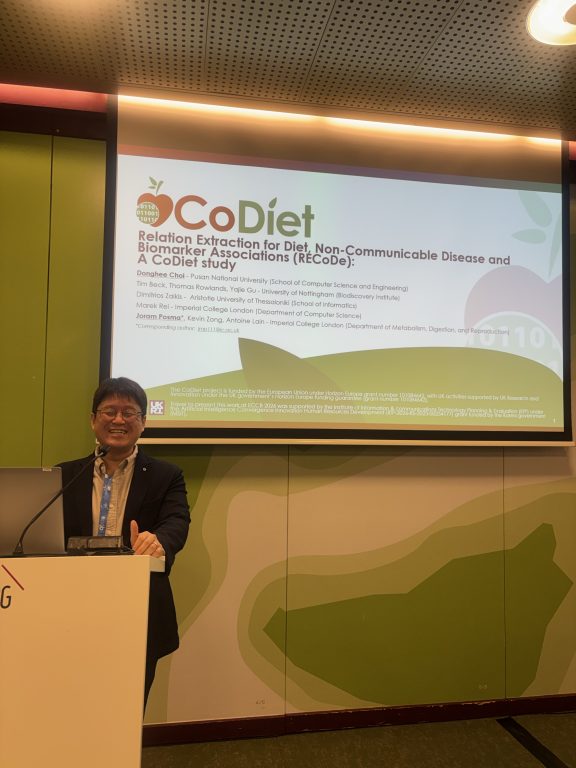
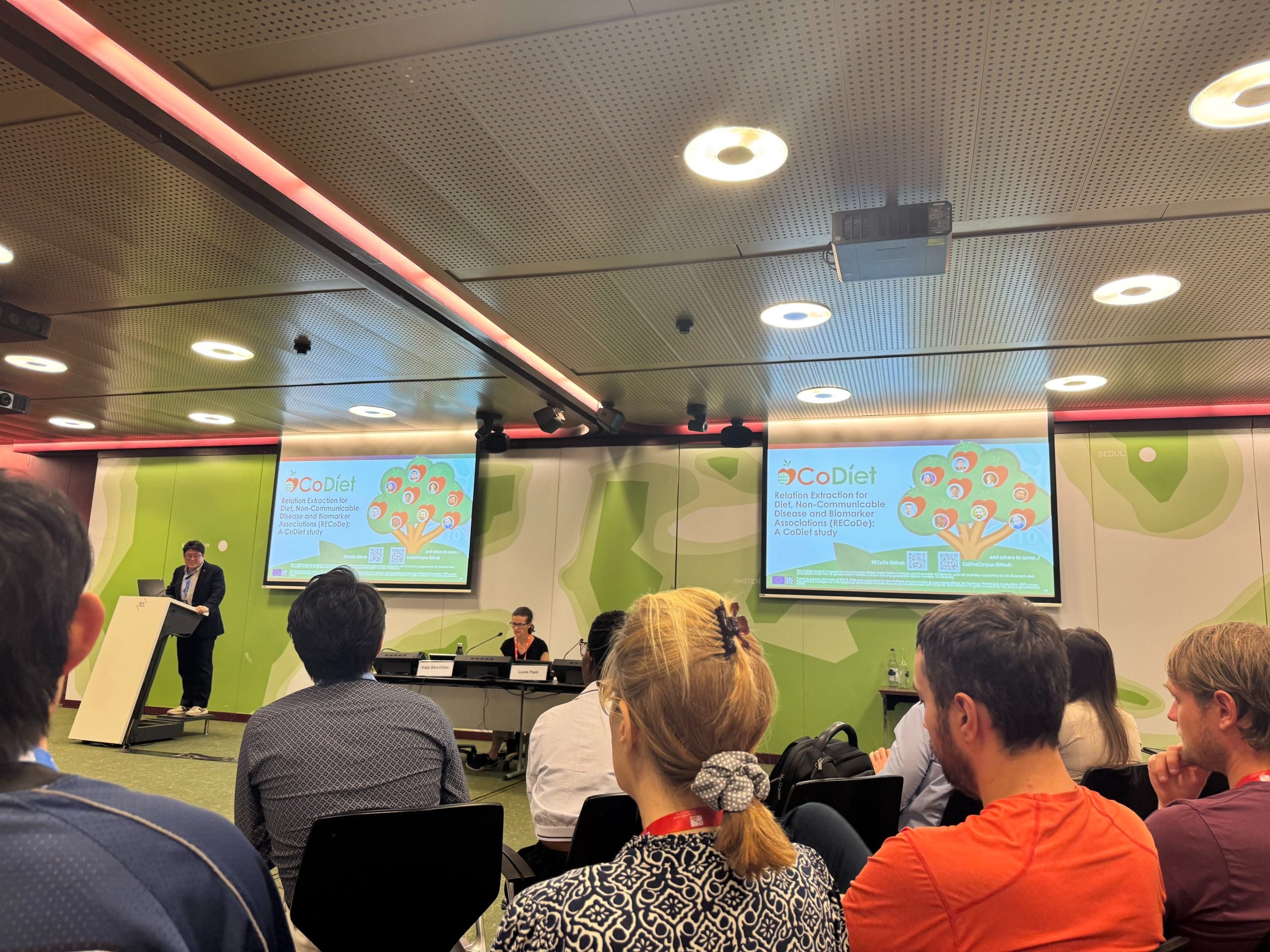
On September 1, 2026, CoDiet researcher Dr Donghee Choi presented at the European Conference on Computational Biology (ECCB) in Geneva, Switzerland.
ECCB is a biannual conference that brings together leading researchers to discuss the latest advancements in genomics, structural bioinformatics, systems biology, biodiversity, and a wide range of other topics. This year, the conference marked its 25th year under the theme ‘Biodiversity, AI & Health: computational biology to address the challenges of our time’.
Dr Choi contributed to CoDiet Work Package 1 (WP1), Technology-assisted Literature Triage, while working as a Research Associate at CoDiet partner, Imperial College London. He is now an Associate Professor at Pusan National University in Busan, South Korea.
Dr Choi delivered a presentation on the paper, ‘Relation extraction for diet, non-communicable disease and biomarker associations (RECoDe): a CoDiet study’.
About RECoDe
What we eat has a major impact on our health, and understanding the connection between diet and disease could reduce the risk of many diseases. As research investigating the links between dietary habits, disease outcomes and biomedical markers continues to grow, it becomes increasingly difficult for scientists to identify and organise all the relevant evidence published in the scientific literature. One challenge is the lack of specialised datasets that allow artificial intelligence (AI) tools to automatically extract and classify information about diet-health relationships.
To address this issue, researchers in CoDiet developed RECoDe (Relation Extraction for Diet, Non-communicable Disease and Biomarker Associations), the first large-scale dataset specifically designed to capture relationships between dietary factors, diseases, and other biomedical markers. RECoDe contains more than 5,000 examples that were carefully annotated and reviewed by multiple human experts, ensuring a high-quality resource for training and evaluating AI systems.
RECoDe provides an important new resource for nutrition and health research. By helping AI systems automatically identify, extract and summarise evidence from large volumes of scientific literature, it could make nutrition research more efficient and support a better understanding of how diet influences health and disease.
In the future, tools built using RECoDe could help researchers conduct systematic reviews more quickly and identify new insights from the rapidly growing body of nutrition research.
Building on CoDiet Research
One of Dr Choi’s current projects has grown from the CoDiet WP1 research. Funded by the National Research Foundation of Korea, the project explores how nutrition advice applies to real-world food choices, focusing on recipes and dishes that people actually eat.
The aim is to determine whether recommendations about specific meals are supported by scientific evidence, rather than assuming that broad dietary guidelines can always be applied to individual dishes. To do this, the project compares recommendations against a disease-diet knowledge graph developed through the CoDiet research, which brings together evidence from the scientific literature.
This approach makes it possible to assess whether advice about a particular dish is consistent with what research studies show about the relationship between diet and health.
The code, models, and dataset are publicly available at https://github.com/omicsNLP/RECoDe
Contributing authors of RECoDe:
- Yajie Gu, University of Nottingham, United Kingdom
- Kai Qi Zong, Imperial College London, United Kingdom
- Antoine Lain, Imperial College London, United Kingdom
- Dimitrios Zaikis, Aristotle University of Thessaloniki, Greece
- Thomas Rowlands, University of Nottingham, United Kingdom
- Marek Rei, Imperial College London, United Kingdom
- Tim Beck, University of Nottingham, United Kingdom
- Joram Posma, Imperial College London, United Kingdom